Visitors to the Eötvös Loránd University of Sciences in Budapest are greeted by a perpetual book with leaves of water.

Assignment
A reference to a number of consecutive pages from a book is usually noted as m–n, with $$m \in \mathbb{N}_0$$ the number of the first page and $$n \in \mathbb{N}_0$$ the number of the last page (with $$m < n$$). A reference to a single page with number $$m$$ is simply noted as m (so we never write m–m).
If the numbers $$m$$ and $$n$$ have the same number of digits, the notation is often abbreviated by removing the longest common prefix in the digits of $$m$$ and $$n$$ from $$n$$. For example, the notation 1234–1247 can be abbreviated to 1234–47 by removing the longest common prefix 12 from 1247. We can therefore easily recognize that m–n is an abbreviation, given that in this case $$m > n$$.
Input
A reference to a number of consecutive pages from a book. This can either be a reference to a single page or a range of more than one page. In the latter case, both the long notation or the short notation can be used.
Output
The total number of pages in the given reference. When counting pages, both the first and the last page of the reference are taken into account.
Example
Input:
1234Output:
1Example
Input:
99-103
Output:
5
Example
Input:
1234-1247
Output:
14
Example
Input:
1234-47
Output:
14
Epilogue: stairs of knowledge
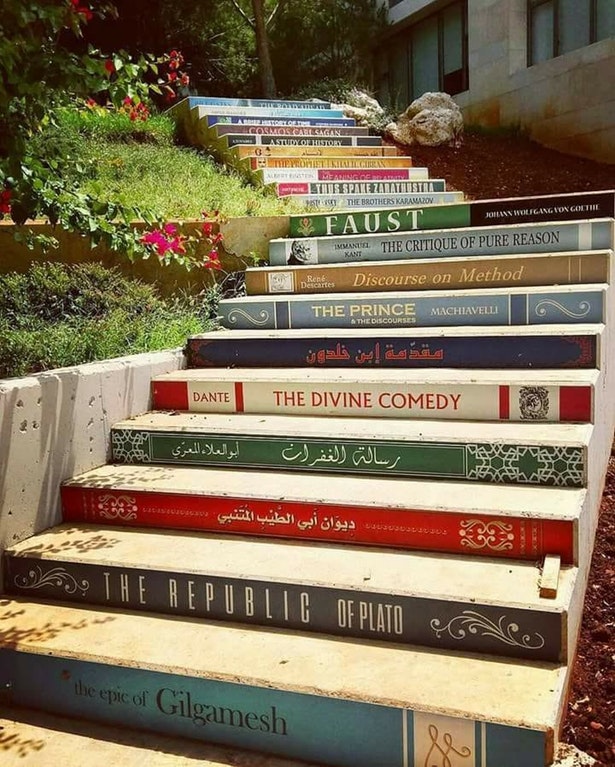
This staircase near the library at Lebanon's University of Balamand is painted to resemble a stack of classic texts:
-
Republic (Greek: Πολιτεία, Politeia; Latin: Res Publica) by Plato
-
The Epistle of Forgiveness (Arabic: رسالة الغفران, Risālat al-ghufrān) by Abī al-Alā al-Ma’arrī
-
Divine Comedy (Italian: La Divina Commedia) by Dante Alighieri
-
The Prince (Italian: Il principe) by Niccolò Machiavelli
-
Discourse on the Method (French: Discours de la Méthode) by René Descartes
-
Critique of Pure Reason (German: Kritik der reinen Vernunft) by Immanuel Kant
-
The Brothers Karamazov (Russian: Братья Карамазовы, Brat'ja Karamazovy) by Fyodor Dostoevsky
-
Thus Spoke Zarathustra (German: Also sprach Zarathustra) by Friedrich Nietzsche
-
Relativity: The Special and the General Theory by Albert Einstein
-
The Days (Arabic: الايام, al-Ayyām) by Tāhā Husayn
This puts them (almost) in chronological order.