Les Prophéties is a collection of prophecies by French apothecary Michel de Nostredame — better known by his Latinized name Nostradamus. The first edition of the book appeared in 1555 by the publishing house Macé Bonhomme. The completed work consists of 3525 quatrains (four-line poems), united in ten sets of centuries.
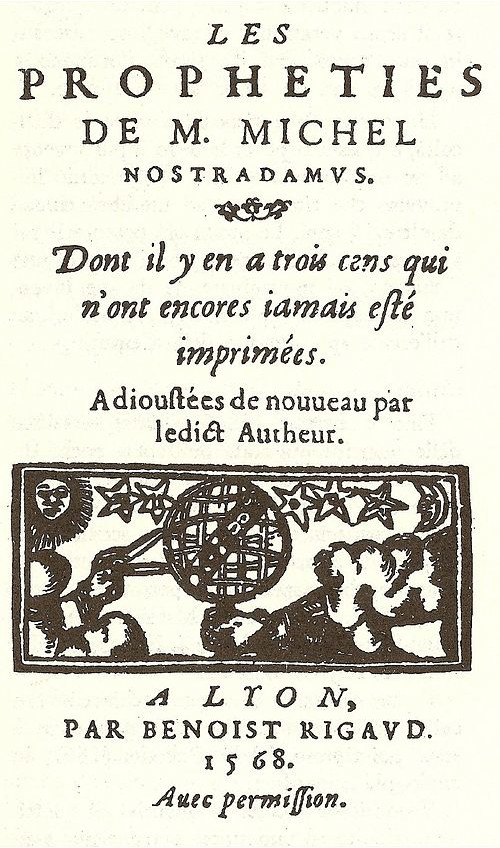
Nostradamus gained notoriety for the belief in his ability to predict the future. His mysterious and often cryptic quatrains foretell significant disasters and other historical events. However, his predictions are filled with ambiguity, do not follow chronological coherence and are written combining French, Greek, Latin and Occitan. They can be attributed multiple meanings when reflecting on the historical context and scrutiny that Nostradamus faced in his lifetime. It is believed they contain anagrams, mythological and astrological references, in a subjective language that makes comprehension difficult. Some scholars claim that Nostradamus played such tricks to evade the Inquisition, for fear of being persecuted for heresy.
Upon closer examination, we have discovered a new technique that Nostradamus used to hide secret messages in his prophecies. Take, for example, this quatrain from the original French edition:
Le Roy voudra en cité neufue entrer,
Par ennemis expugner l'on viendra
Captif libere faux dire & perpetrer,
Roy dehors estre, loin d'ennemis tiendra.
If you concatenate the fifth letter of the words (with at least five letters) in the first line, you get rue. Similarly, you get sea by concatenating the seventh letter of the words in the second line, ire by concatenating the fifth letter of the words in the third line, and sir by concatenating the sixth letter of the words in the fourth line. Surely that can't be a coincidence, no?
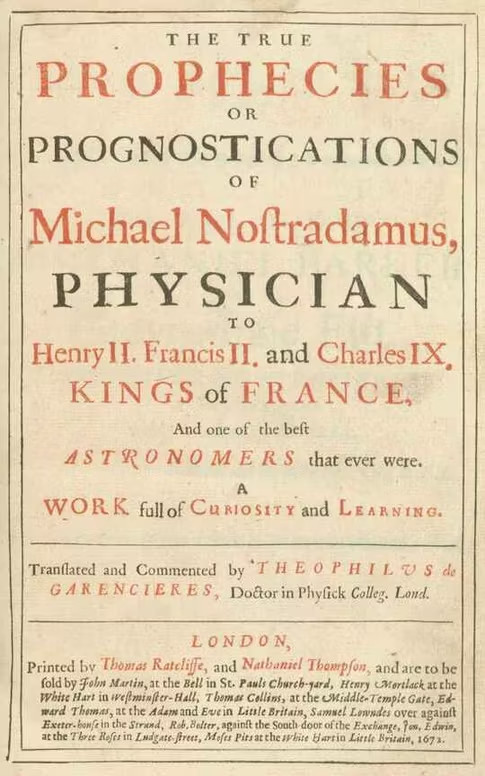
The first English edition — entitled The True Prophecies or Prognostications of Michael Nostradamus — was published in London by Thomas Ratcliffe and Nathaniel Thompson, in the year 1672. Their English translation of this quatrain shows that Ratcliffe and Thompson must have understood the technique of hiding secret messages:
Between the two distant monarchs,
When the clear Sun is lost through "Selin":
Great enmity between two indignant ones,
So that liberty is restored to the Isles and Siena.
If you concatenate the fifth letter of the words in the first line, you get ear. Similarly, you get run by concatenating the fifth letter of the words in the second line, yen by concatenating the sixth letter of the words in the third line, and rosa by concatenating the fifth letter of the words in the fourth line. It's somewhat subtle, but can you see the connection between ear, run, yen, and rosa?
Assignment
Determine the word obtained by concatenating the $$n$$-th letter of words having at least $$n$$ letters in a sentence.
Input
A line with a number $$n \in \mathbb{N_0}$$, followed by a second line with a sentence.
Output
The word obtained by concatenating the $$n$$-th letter of words having at least $$n$$ letters in the sentence. As such, no letters must be selected from words having fewer than $$n$$ letters. The uppercase and lowercase letters selected from the sentence must be retained as such.
The words in the sentence are formed by the longest possible sequences of consecutive letters. You must take into account that letters can also have diacritics, such as Å, è, ç, or ñ.
Example
Input:
3
Vicaire au Prone, pris Cité, ceux d'Ausone.
Output:
coitusIn the figure below, we have marked the letters of the example sentence in blue and the characters that are not letters in yellow. Above each character is the position of the letter within its word, or zero if the character is not a letter. This also illustrates that d'Ausone are two separate words (d and Ausone), not one word.

The red circles mark the third letters in a word, which together form the word coitus. The words au and d are too short, so no letters are selected from these words.
Epilogue
Sixteenth-century prophet Nostradamus predicted three Antichrists. The first two are thought to have been Napoleon and Hitler, but the third — known only as "Mabus" — hasn't shown up yet. Here are the relevant quatrains:
Mabus will soon die, then will come
A horrible undoing of man and beast,
We will see vengeance at once,
One hundred powers, thirst, famine, when passes the comet.
His hand finally through the bloody ALUS,
He will be unable to protect himself by sea,
Between two rivers he will fear the military hand,
The black and angry one will make him repent of it.
What does this mean? Who knows? Presumably it will make sense at the time.