Monster Mash
Every Halloween, monsters get together to celebrate the season by hosting parties called “Monster Mashes”. They’re a real graveyard smash, we assure you. Your team has been hired to help do party planning in the future, and all good party planning starts with data analysis. You have collected some example data from past Monster Mashes, and will need to write some functions to process that data.
You do not define the dataclasses and test data for this assignment, you only define the functions to process the data.
The diagram below helps explain the format of the MonsterMash dataclass and its associated classes Party, Monster, Media, Potion, and Ingredient.
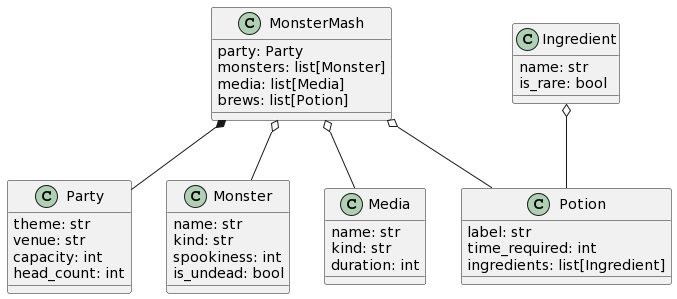
The descriptions of each of the classes is as follows:
MonsterMash: All of the data related to a single instance of a monster party, including the party metadata, some of the key monsters attending, what media they enjoyed, and the drinks they had (brews).Party: Metadata about the party including its name, venue, and size.Monster: A representation of a specific monster attending the party.Media: Either a song, movie, or game that is played at the party.Potion: A (possibly delicious) magical potion that can be consumed to produce a certain magical effect. Requires ingredients and time to brew.Ingredient: A specific ingredient for a potion. May or may not be rare.
Notice that some of these dataclasses are lists in the MonsterMash dataclass, not just single instances! In fact, only the party field is actually a single dataclass - all the other fields are lists!
The Data
You have four existing MonsterMash instances to use as test data. And good news, that should be all you need for this assignment. Although you are free to write more test cases if it helps you think, you are not required to write any additional ones. All of the test data has been written for you.
You may find it helpful to review the actual data of the Monster Mashes, so you understand how the values were calculated. The data is in the monster_mash.py file (you will also find the file in each programming problem of this assignment, as a tab in the sandbox).
Examples
Example 1: Define a function get_party_size that consumes a Party and determines if the party is "large" (40 or more monsters), "small" (less than 20 monsters), or "medium".
from bakery import assert_equal
from monster_mash import *

def get_party_size(party: Party) -> str:
    """
    Determines if a party is "large", "medium", or "small" based
    on the headcount.
    """
    if party.head_count >= 40:
        return "large"
    elif party.head_count < 20:
        return "small"
    else:
        return "medium"

assert_equal(get_party_size(party1.party), "small")
assert_equal(get_party_size(party2.party), "small")
assert_equal(get_party_size(party3.party), "medium")
assert_equal(get_party_size(party4.party), "large")
Example 2: Define a function count_werewolves that consumes a list of Monsters and produces the number that are of kind "werewolf".
from bakery import assert_equal
from monster_mash import *

def count_werewolves(monsters: list[Monster]) -> int:
    werewolves = 0
    for monster in monsters:
        if monster.kind == 'werewolf':
            werewolves = werewolves + 1
    return werewolves

assert_equal(count_werewolves(party1.monsters), 0)
assert_equal(count_werewolves(party2.monsters), 3)
assert_equal(count_werewolves(party3.monsters), 0)
assert_equal(count_werewolves(party4.monsters), 1)