What is Mutability?
- Mutability: The value itself can change.
- Immutability: Only new values can be produced, based on that value.
Mutability is an important concept now that we have more advanced data structures. Fundamentally, the idea is whether values of the given type can change their inherent value, or if the value cannot change what it is. When we store values into variables, we often need to consider whether that variable is holding a mutable value. Many kinds of bugs can occur when we try to use an immutable value mutably or a mutable value immutably.
Mutability of Types
- Immutable: Strings, floats, integers, booleans
- Mutable: Lists, Dataclasses
Strings and lists are similar because they are both sequences of elements - you can index them, subscript them, perform membership tests on them, and many other common actions. However, a big difference between them is their Mutability. Strings are immutable while lists are mutable. Integers and other primitive types are all immutable, in fact, while lists and dataclasses are mutable.
Immutable Primitives
name = "Ada Bart"
print(name)

# The following line doesn't change `name`
name.lower()
print(name)

# The following line doesn't change `name`
lowered_name = name.lower()
print(lowered_name)
print(name)

# Now `name` has been changed!
name = name.lower()
print(name)
Say you have a string variable. When you add another string to that variable’s value, you need to assign the result - otherwise the combined value is lost. Similarly, when you call a string method, you need to assign the result - otherwise the new value is lost. This is the idea of immutability - you are never changing the string; you are simply creating new strings instead. Integers and floats follow the same principle: you cannot fundamentally turn the value 5 into a different integer; you are always creating new integers based on the old one, but you cannot change the fact that 5 is 5.
Mutable Lists
grades = [90, 65, 78]
print(grades)

# This adds 98 to the list
grades.append(98)
print(grades)

# Bad! We add 44, but then overwrite the variable
#   `grades` with None, which is returned by `.append()`
grades = grades.append(44)
print(grades)
Now say you have a list variable. Appending a value to the list fundamentally changes the list value itself, so that the list has a different sequence of values inside. This is the idea of mutability, the fact that the list itself can change.
A tricky thing to remember with lists is that if you append a value to the list variable, you must not assign the result back to that variable, unlike with strings. The append method modifies the list variable, and then returns None, so if you assign the method’s result you overwrite the list variable. If you don’t assign back, the append call will mutate the list - changing the data inside the list without affecting the list variable.
Mutable Dataclasses
from dataclasses import dataclass

@dataclass
class Dog:
    name: str
    age: int

babbage = Dog("Babbage Bart", 5)
print(babbage.name)
# Mutably update the instance
babbage.name = "Sir Babbage Bart"
# Value will have changed!
print(babbage.name)
Dataclasses can also be mutated. Any time you assign to an instance’s field, you are modifying the instance. In the example shown, we create an instance of a Dog dataclass, and then later update its name field. Afterwards, the name field has a different value. In this way, you can also see how fields are like variables.
Mutability and Parameters
def add_x(a_list: list[str], a_str: str):
    a_list.append("X")
    a_str = a_str + " X"

courses = ["A", "B", "C"]
name = "Ada"
add_x(courses, name)
print(courses)
# ["A", "B", "C", "X"]
print(name)
# "Ada"
We have seen mutability before when we learned about parameters of functions. Let’s look at this function add_x that consumes a list and a string and adds the string value "X" to the end. When the function call is over, only the list has been changed. Even though we were using local versions of each variable, the mutability of the list type meant that the original list was changed. If we wanted to change the name variable, we would have had to return the modified value and assign it back to the name variable.
Parameters in Stack/Heap Diagrams
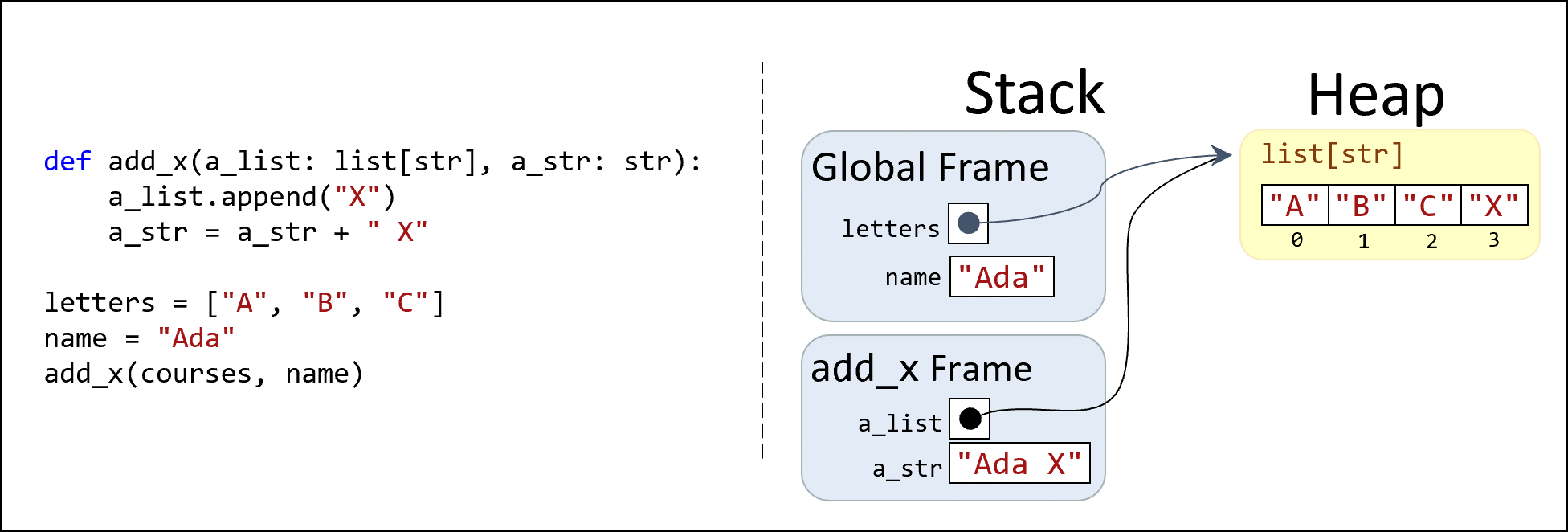
We can visualize the difference in these two values by looking at a Stack/Heap diagram. Notice how there is only one list on the Heap because the same reference is shared between the a_list variable and the letters variable. However, the name and a_str have distinct values because strings are immutable.
Summary
- In Python, all the primitive value types (string, integer, float, and Boolean) are immutable, which means that their intrinsic values cannot be changed for a given instance.
- However, both lists and types created using dataclasses are mutable, which means that instances of those types can have their internal values changed.
- When updating variables holding string variables, you must assign the newly computed value back to the same variable.
- When updating lists, you call the
appendmethod and must not assign the result to the list variable. - Instances of lists and dataclasses passed in as parameters can be mutated, which means that any global variables referencing those instances will also have those updates. However, this does not apply to immutable types like strings and integers.