Check your understanding of the previous reading: the parts of a while loop, when a while loop stops, and how while loops compare to for loops.
Question 1
Identify each part of the while loop shown:
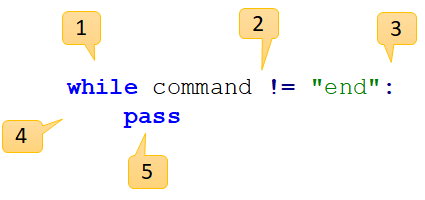
| Label | Points at | Part |
|---|---|---|
| 1 | while | |
| 2 | command != "end" | |
| 3 | : | |
| 4 | the start of the second line, left of pass |
|
| 5 | pass |
💡 Get a hint
Read the first line from left to right: the keyword, the condition it checks, and the character that ends the line. Labels 4 and 5 are about the second line: how it is placed, and what it holds.
👁 Show solution
1 While keyword (while), 2 Conditional (command != "end"), 3 Colon, 4 Indentation (the spaces before pass), 5 Body (pass).
Question 2
Syntactically, while loops look just like for loops. They both have a keyword, a colon, and a list to iterate over.
Select one answer, then check.
-
Not quite. A
whileloop has no list to iterate over: after the keywordwhilecomes a condition, as in anifstatement. -
Correct. Both start with a keyword and end their first line with a colon, but a
whileloop has a condition where aforloop has a list.
Question 3
A While loop will always execute at least once.
Select one answer, then check.
-
Not quite. The condition is checked before the body runs the first time; if it is false then, the program skips the body entirely.
-
Correct. If the condition is false the first time it is checked, the body never runs.
Question 4
The program below will NOT loop forever.
count = 10
while count >= 0:
    count = count - 1
print(count)
Select one answer, then check.
-
Correct.
countgoes down by one on every pass, so it reaches -1 and the conditioncount >= 0becomes false. -
Not quite.
countgoes down by one on every pass, so once it reaches -1 the conditioncount >= 0is false and the loop ends.
Question 5
The program below will NOT loop forever.
count = 0
while count > 0:
    count = count + 1
print(count)
Select one answer, then check.
-
Correct.
countstarts at 0, socount > 0is false the first time it is checked: the body never runs, and the program prints 0. -
Not quite. The body would increase
countforever, but it never runs:count > 0is already false whencountis 0.
Question 6
The program below will NOT loop forever.
alpha = 'dog'
while alpha == 'dog':
    alpha = 'cat'
    print(alpha)
    alpha = 'dog'
print(alpha)
Select one answer, then check.
-
Not quite.
alphais'cat'only in the middle of the body; by the end of every pass it is'dog'again, so the condition is true every time it is checked. -
Correct. The condition is only checked at the start of each pass, and by then
alphais always back to'dog', so the loop never ends.
Question 7
The program below will NOT loop forever.
while True:
    print("Loop again")
Select one answer, then check.
-
Not quite. The condition is the value
True, which never becomes false, and nothing in the body stops the loop. -
Correct. The condition is the value
True, which never changes, so the loop printsLoop againforever.
Question 8
while loops are more common in Python than for loops because they are safer.
Select one answer, then check.
-
Not quite.
forloops are the most common form of iteration in Python, and they are the safer one: they end when the list runs out, while awhileloop can easily loop forever by accident. -
Correct. It is the other way around:
forloops are more common, and safer, because they end when the list runs out.
Question 9
A while loop will execute once for each expression in the conditional.
Select one answer, then check.
-
Not quite. The number of passes has nothing to do with the expressions in the condition: the body repeats for as long as the condition is true.
-
Correct. A
whileloop repeats its body for as long as the condition is true, however many expressions the condition has.
Question 10
Which of the following have a body?
Select every answer that applies, then check.
-
Correct. The indented statements under the
whileline are its body. -
Correct. The indented statements under the
forline are its body, which runs once for each element. -
Correct. The indented statements under the
defline are the body of the function. -
No body. A call runs the body of a function that was defined elsewhere; the call itself has no indented block.
-
Correct. The indented statements under the
ifline are its body. -
No body. Looking up a value is an expression, not a block of indented statements.