This problem involves writing functions.
Questions
Some of the exercises are not tested by Dodona (for example the plots), but it is still useful to try them.
- Write a function,
Power(), that prints out the result of raising 2 to the 3rd power. In other words, your function should compute \(2^3\) and print out the results to the console. Run the commandPower()and verify if it prints8to the console.Hint: use the
print()function to output the result. - Create a new function,
Power2(), that allows you to pass any two numbers,xanda, and prints out the value ofx^ato the console. You can do this by beginning your function with the linePower2=function(x,a){You should be able to call your function by entering, for instance,
Power2(3,8)on the command line. This should output the value of \(3^8\), namely, 6561.
-
Using the
Power2()function that you just wrote, compute \(10^3\), \(8^{17}\), and \(131^3\). - Now create a new function,
Power3(), that actually returns the resultx^aas an R object, rather than simply printing it to the screen. That is, if you store the valuex^ain an object calledresultwithin your function, then you can simplyreturn()this result, using the following line:return(result)The line above should be the last line in your function, before the
}symbol. -
Test your function
Power3()by computing \(7^4\) using the function and assign the result to the variablepower3.test. Notice that the result of \(7^4\) will only be printed to the console if you printpower3.test. -
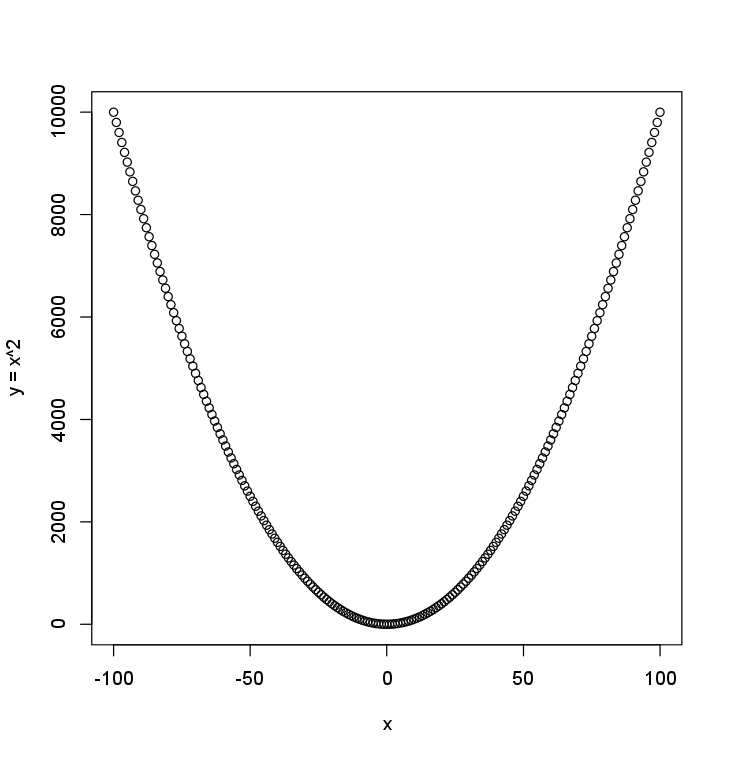
Try to recreate the following plot:
- Create a numeric vector with integers ranging from -100 to 100. Store the result in
x. - Now using the
Power3()function, create a numeric vector \(f(x) = x^2\). Store the result iny. - Use the
plot()function to verify that your variablesxandyare correct.
- Create a numeric vector with integers ranging from -100 to 100. Store the result in